|
Stapled
Brushes |
|
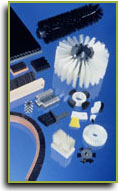
Stapled brushes consist
of a series of individual tufts of fill inserted into a bored hole in a
solid block of wood or plastic. The tufts of fill are secured to the
block by a wire staple.
The most commonly used
brush construction, stapled brushes can be made in endless shapes and
sizes. A wide variety of hole or tuft patterns are used to
accomplish the desired effect of the brush application. Various
types and sizes of fill materials can be used. Several block
materials can also be used for the round core or flat base of the
brush. Blocks can be bored for straight or angle filled holes.
Close tolerances can be maintained depending on the materials
used.

Flat
Most common shape used unless there are specific reasons for
using other shapes. |
Bevel
Reduces brush resistance and conforms to surface being
brushed. |
Concave or Convex
To conform to the surface being
brushed. | |

|
Step
For brushing irregular or uneven surfaces. Many
variations are possible. |
Double
Bevel
To conform to the surface being brushed. |
Combination
Step
Combination of step trims to conform to the surface being
brushed. |
Chisel or
Converging
Allows for greater concentration of brush fill to obtain
more brushing
action. | |
|
Fills Materials,
Sizes and Colors |
| Several fill materials are
available and used in stapled brushes. Materials used are bristle,
horse hair, goat hair, tampico, nylon, polypropylene, abrasive nylon,
brass, carbon steel, stainless steel and phosphor bronze. Blends,
various mixtures of fill materials used together, as are available as
well.
Synthetic filament sizes range
from .0025 to .060 and more while wire sizes range from .003 to
.020. Filament type and sizes are determined by the application
requirement. Filaments other than natural materials can be provided
either crimped or straight (level) depending on application and
requirements.
Synthetic filaments are
generally black or natural (white) in color. However, synthetics are
available in a wide range of colors. |
|
Block
MaterialsA variety of
solid block materials are used for practically any application and
requirement. Blocks can be shaped to fit in practically any mounting
or holding mechanism. Close tolerances can be maintained depending
on the block material and requirement. Most common materials are
hard woods, rubber, aluminum, leather and molded or extruded
plastics. Several types of plastics are used such as PVC, Urethane,
Delrin, Polypropylene and Flexible PVC. |
StaplesStapling
provides consistent product quality and reliability. The staple, as
shown in the illustrations, is a primary part of the brush. The
staple holds the fill material in the block. Tempered steel staple
wire is generally used, however stainless steel and brass staple wire can
also be furnished. The type of staple wire used is predicated by the
environment and conditions the brush will be performing
under.
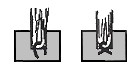
Straight
Most commonly used. Usually with
hole size of 3/32" and up. |
Crossover
Used for greater tuft retention.
Usually with hole size of 3/32" and
up. | |
|
Hole
PatternsAn extremely
wide variety of designs and densities are provided in stapled brushes to
accomplish the desired effect for the application and requirement.
The function of the brush and filament size determines the density and
size of the tuft holes.
Patterns can be extremely
dense to very open. Blocks generally bored straight, can be angled,
flared, or converged to allow for specific trim shapes and to meet
specific applications. Each pattern is specially designed for the
application. Hole patterns can also be designed around mounting and
fixture holes without affecting the function of the brushing action.
Patterns, shown below, illustrate the design for either a flat or
developed cylinder. |